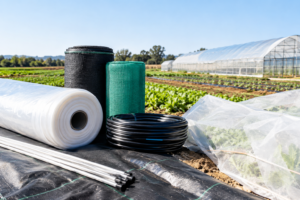
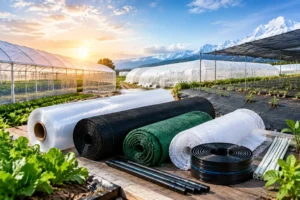
Modern farming requires more than seeds, fertilizers, and machinery. Farmers also need reliable agricultural materials to protect crops, manage water, control weeds, and improve growing conditions.
Today, commercial farms use different materials at different stages of crop production. For example, greenhouse growers may use greenhouse film and insect netting, while open-field farms often combine mulch film with drip irrigation tape.
This agricultural materials guide introduces the main products used in modern farming and explains their common applications.
What Are Agricultural Materials?
Agricultural materials are products that support crop production, crop protection, water management, soil management, and agricultural structures.
The main types include:
- Insect Net
- Shade Net
- Greenhouse Film
- Agricultural Mulch Film
- Weed Control Fabric
- Drip Irrigation Tape
- Fiberglass Rod
Each product serves a specific purpose. However, farmers can also combine several products to create a complete crop production system.
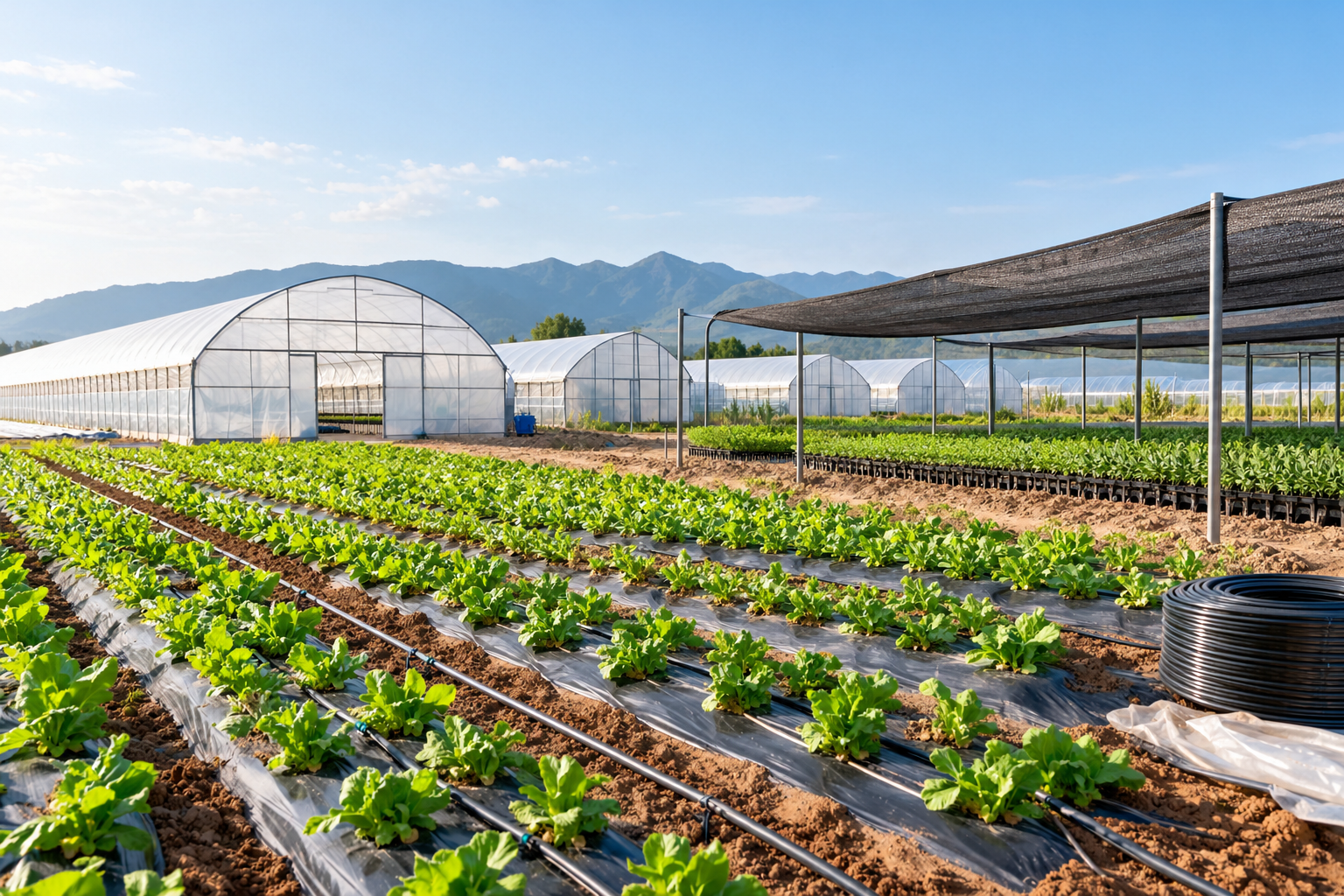
Essential Agricultural Materials for Modern Farming
Insect Net for Crop Protection
Insect net helps farmers create a physical barrier against many common agricultural pests. At the same time, the mesh allows air and light to reach the crops.
Farmers commonly install insect netting on greenhouse vents, tunnels, nurseries, and other protected cultivation structures.
For example, vegetable growers can use insect netting to protect young plants during critical growth stages. Therefore, buyers should select the mesh size according to the target pest, crop, and growing environment.
When purchasing insect net, also consider material quality, UV resistance, mesh size, width, and service life.
Shade Net for Light Management
Strong sunlight can create difficult growing conditions for many crops. Shade net helps growers reduce excessive solar radiation and manage light levels.
Nurseries, greenhouses, orchards, and vegetable farms commonly use shade net. In addition, different shading percentages allow growers to select a suitable level for different crops.
For commercial projects, buyers should compare shading percentage, weight, width, UV resistance, and durability. Most importantly, the selected shade level should match the crop and local climate.
Greenhouse Film for Protected Agriculture
Greenhouse film forms an important part of modern protected cultivation. It covers greenhouse structures and helps growers create a more controlled growing environment.
Commercial growers use greenhouse film for vegetables, flowers, seedlings, and nursery production.
Different films provide different levels of light transmission, UV resistance, thermal performance, and durability. Therefore, buyers should consider the local climate, greenhouse structure, crop requirements, and expected service life before making a selection.
Agricultural Mulch Film for Soil Management
Agricultural mulch film covers the soil around crops. Farmers commonly use it in vegetable production, fruit cultivation, and field farming.
The material can help farmers manage soil moisture, suppress weed growth, and regulate soil temperature. As a result, mulch film can support more efficient field management.
However, different crops require different specifications. Buyers should check film thickness, width, color, material, and application method before placing an order.
Weed Control Fabric for Long-Term Ground Coverage
Weed control fabric provides a practical solution for long-term ground management. Unlike short-term mulch applications, growers often use this fabric in areas that require extended coverage.
Nurseries, orchards, greenhouses, and commercial plant production facilities commonly use weed control fabric.
The fabric helps reduce weed growth while allowing water and air to pass through. Therefore, it can reduce the need for frequent manual weed removal in suitable applications.
When sourcing this product, buyers should evaluate fabric density, strength, UV resistance, dimensions, and expected service life.
Drip Irrigation Tape for Water Delivery
Water management plays an important role in modern agriculture. Drip irrigation tape delivers water along crop rows and helps growers target the root zone.
Farmers commonly use drip tape in greenhouses, vegetable fields, nurseries, and large-scale farming projects.
Manufacturers offer different diameters, wall thicknesses, emitter spacing, and flow rates. Therefore, buyers should select the specification according to crop spacing, irrigation pressure, water quality, and field layout.
In addition, buyers should consider the compatibility between the drip tape and the existing irrigation system.
Fiberglass Rod for Agricultural Support
Fiberglass rods provide lightweight support for agricultural structures and crop protection systems.
Growers can use them with insect nets, tunnels, plant supports, and other agricultural structures. In addition, fiberglass offers a combination of strength, flexibility, and low weight.
Before purchasing fiberglass rods, buyers should check the diameter, length, strength, flexibility, and application requirements.
Agricultural Materials for Different Farming Systems
Different farming systems require different material combinations.
Greenhouse Farming
Greenhouse growers often combine greenhouse film, insect net, shade net, drip irrigation tape, and fiberglass rods.
Together, these materials can support crop protection, light management, water delivery, and greenhouse structure requirements.
Open-Field Farming
Open-field farms commonly use mulch film and drip irrigation tape. Depending on the crop and local conditions, farmers may also use insect netting and other crop protection materials.
Nursery Production
Nurseries often require shade net, insect net, weed control fabric, and fiberglass rods.
These materials help growers manage light, protect young plants, control weeds, and build simple support structures.
Orchard Management
Orchard growers can use drip irrigation systems, weed control fabric, insect netting, and other crop protection materials.
Because orchard materials often remain outdoors for long periods, buyers should pay particular attention to UV resistance and product durability.
What Should B2B Buyers Consider?
For importers, wholesalers, distributors, and agricultural project buyers, product price represents only one part of the purchasing decision.
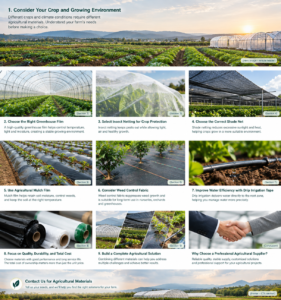
First, check the product specifications. Make sure the size, thickness, mesh, shading level, or flow rate matches the intended application.
Next, evaluate material quality and UV resistance. Outdoor agricultural products face sunlight, rain, temperature changes, and mechanical stress.
In addition, review the supplier’s quality control and production capacity. Consistent quality becomes especially important when buyers place repeat orders or purchase for large agricultural projects.
Finally, consider packaging, customization, MOQ, and shipping requirements. These factors can affect the total purchasing cost and supply efficiency.
Conclusion
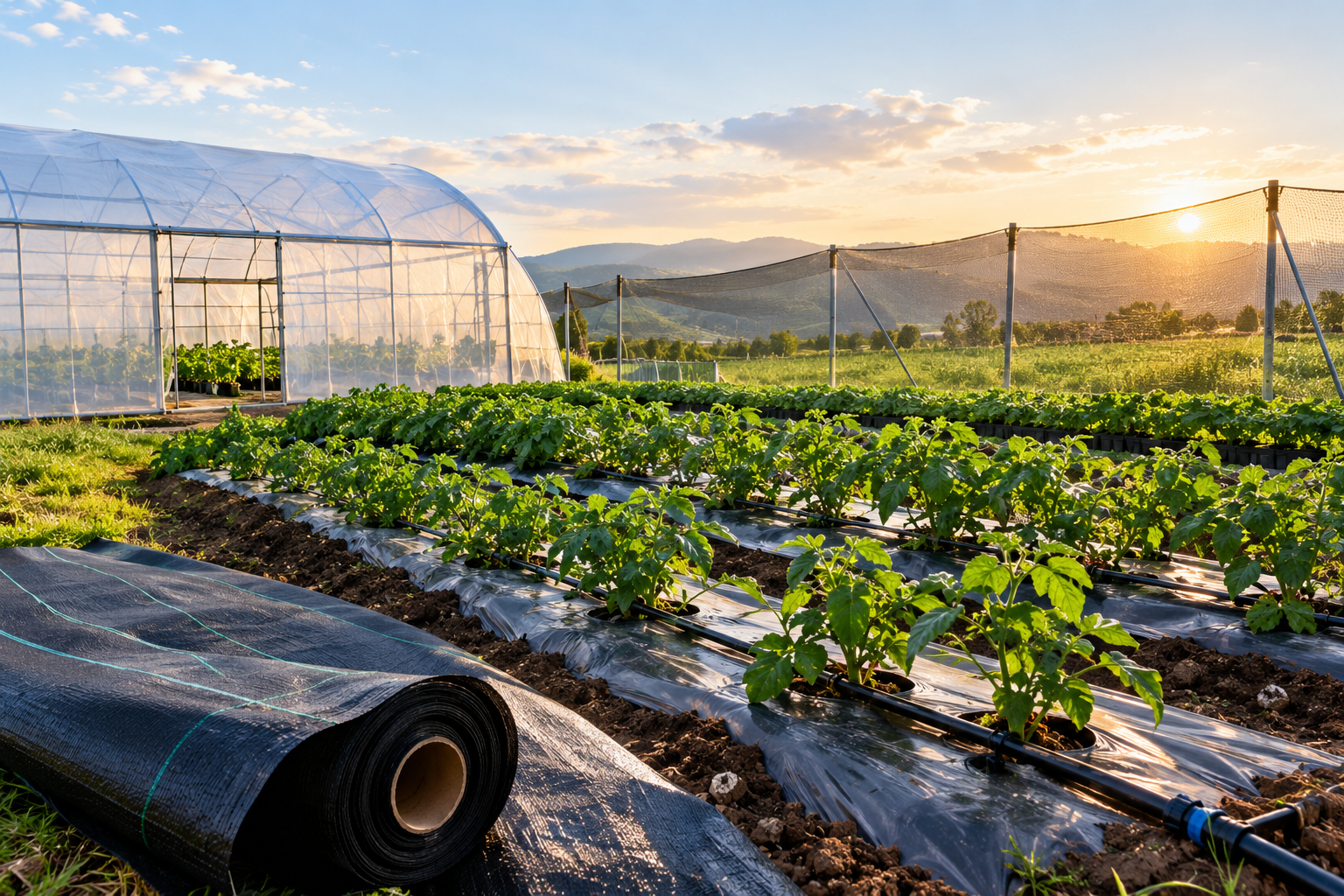
Agricultural materials support many areas of modern farming. Insect nets protect crops, shade nets manage sunlight, and greenhouse films support protected cultivation. Meanwhile, mulch film and weed control fabric help manage growing areas, while drip irrigation tape improves targeted water delivery.
For commercial farms and B2B buyers, the right material combination depends on the crop, climate, cultivation method, and project requirements.
Therefore, buyers should evaluate product specifications, durability, quality control, supply capacity, and application requirements before placing an order.
If you are sourcing insect nets, shade nets, greenhouse films, mulch films, weed control fabrics, drip irrigation tapes, or fiberglass rods, a professional agricultural materials supplier can help you select suitable products for your specific farming application.